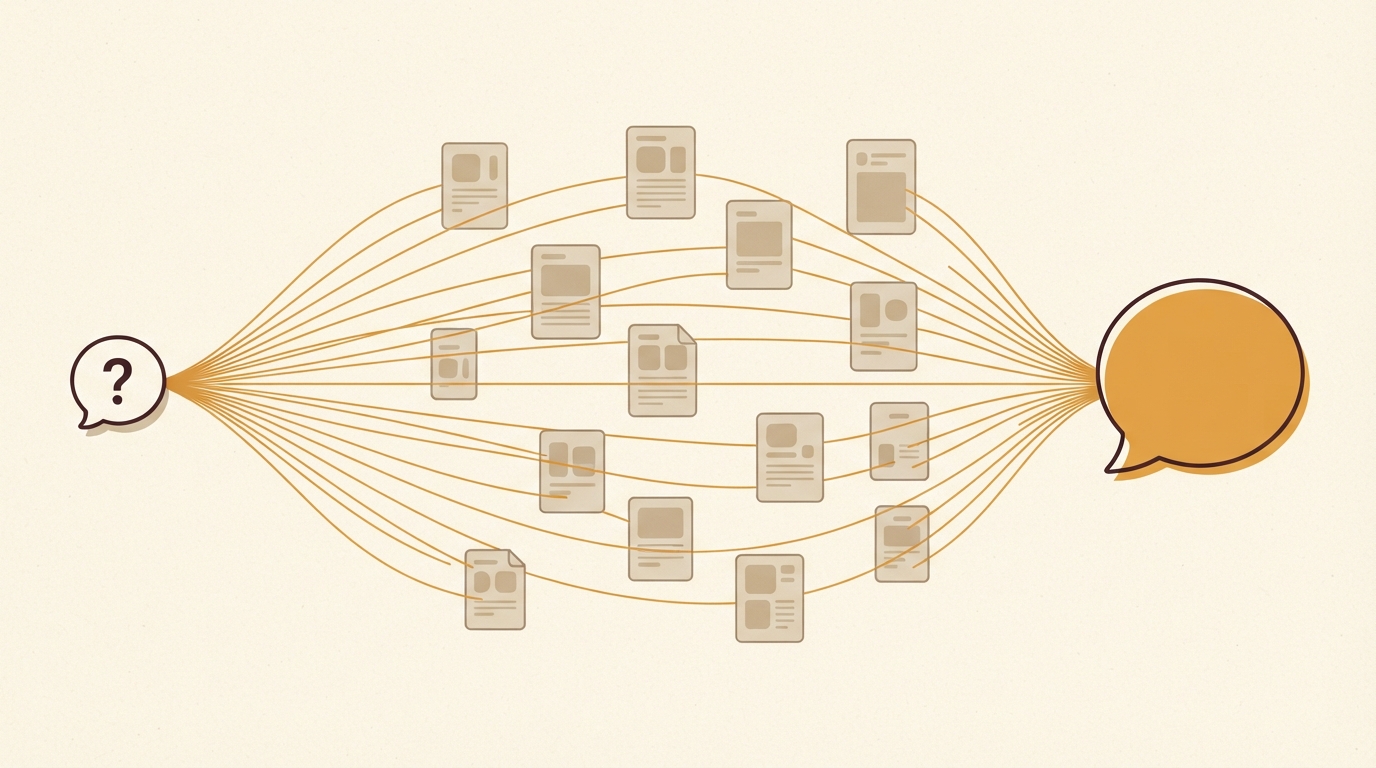
Most advice about AI search skips the part that matters: what actually happens between someone typing a question and a business getting named. Without that, the advice is superstition: do these six things because they seemed to work once.
The mechanism is knowable. Not perfectly, and not officially in every detail, but enough to reason from. There are four steps, and a local business can lose at any one of them.
Step 1: your question is not the query it runs
When someone asks an answer engine a question, the engine does not go looking for that question. It decomposes it first.
Google calls this query fan-out. Robby Stein, Google's VP of Product for Search, described it plainly in a July 2025 interview: for a question like things to do in Nashville with a group, the system "may think of a bunch of questions like great restaurants, great bars, things to do if you have kids, and it'll start Googling basically." For its Deep Search mode, he said the system "can issue dozens or even hundreds of background queries."
Those sub-queries go out in parallel, and not only to the web index. Stein described integration with Google's real-time systems, Finance, flight data, movie information, and a shopping catalogue of 50 billion products updated roughly two billion times an hour.
What this means for you: you are not being matched against the question the customer asked. You are being matched against a swarm of narrower questions the engine invented on their behalf. "Best dentist in Austin" may fan out into questions about emergency availability, insurance acceptance, sedation options, and pricing, and you are judged separately on each one.
This is why thin, general pages underperform. A single "Services" page competes for none of those sub-questions well. Five specific pages compete for five of them.
Step 2: candidates get gathered
Here the engines differ, and the difference is worth knowing.
Google has its own index and its own real-time systems, so fan-out queries resolve internally.
ChatGPT does not have a web index of its own. When it needs live information,
it issues sub-queries against Bing's search API to discover candidate URLs, then
sends its own fetcher, the ChatGPT-User agent, to read promising pages during
the conversation.

Detailed teardowns of that retrieval stack describe roughly three layers, each with different freshness and different blind spots:
- A discovery layer that finds candidate pages, leaning on Bing.
- A cache holding copies of pages fetched previously, which can serve a stale version of you.
- A live fetch of a small number of pages opened during the conversation.
Two consequences fall straight out of this, and both are actionable. If you are absent or weak in Bing's index, you are frequently not a candidate in ChatGPT at all, regardless of how you do on Google. And if your page is slow, blocked, or renders its content only via JavaScript, a live fetch can come back with nothing useful even when you were selected.
Caveat worth stating: OpenAI does not publish its retrieval architecture. This description comes from independent analysis of observed behaviour, not documentation, and it will change.
Step 3: most candidates are thrown away

This is the step nobody optimizes for, and it is where most businesses actually lose.
Analyses of ChatGPT's citation behaviour suggest it cites only around 15% of the pages it retrieves. The other 85% are found, fetched, read, evaluated, and discarded without ever appearing in the answer.
Being retrieved and being cited are different achievements. Everything traditional SEO does gets you into the retrieved pile. What gets you out of it is narrower:
- Does the page answer the sub-question directly, near the top? A model scanning for an extractable claim will not read to your fourth section.
- Is the claim self-contained? A sentence that depends on the paragraph above it cannot be lifted out.
- Is it checkable? Specific numbers, named plans, stated hours and service areas survive filtering. Adjectives do not.
- Is it fresh? For "best" and "cost" questions, recency is a live tiebreaker.
Recall from the Pew data that the median AI summary is about 67 words drawn from three or more sources. The filter is not choosing your page. It is choosing one or two sentences from it.
Step 4: the answer is written, not looked up
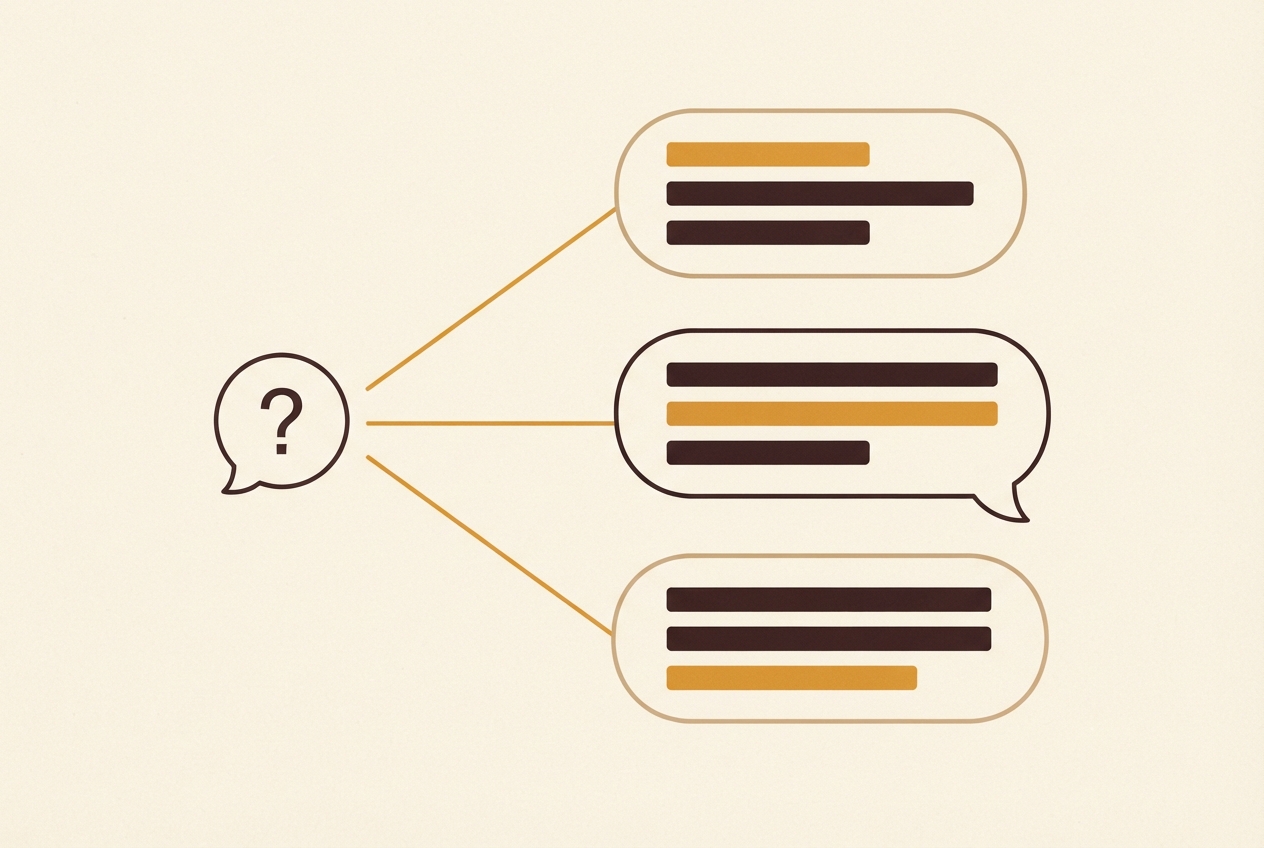
The final step is generation. The model takes what survived filtering and writes a fresh paragraph. It is not retrieving a stored answer. It is composing one, and composition is probabilistic.
That single fact explains the behaviour that most confuses business owners: ask the same question twice and you can get different businesses. Nothing broke. The fan-out may have differed, the retrieved set may have differed, the generation certainly did.
It has an important implication for measurement. There is no rank to look up, so a single check tells you almost nothing: you might have caught a good roll or a bad one. What is real is your rate: across many samples over time, how often does the engine name you? That is a distribution, and only repeated sampling across engines reveals it.
Where a local business actually wins
Map the four steps onto work, and the priorities reorder themselves:
| Step | You lose when | You win by |
|---|---|---|
| Fan-out | One general page competes for many specific sub-questions | One page per real question: cost, insurance, emergency, comparison |
| Retrieval | You are weak in Bing, slow, or JS-dependent | Being indexed everywhere, fast, and readable as plain HTML |
| Filtering | Your answer is buried, hedged, or unverifiable | Leading with a specific, self-contained, checkable claim |
| Generation | You assume one check is the truth | Sampling repeatedly and tracking the rate |
Notice how little of this is about your website's design, and how much is about its structure and your presence elsewhere. That is the honest shape of the work.
FAQ
Does ChatGPT use Google to find local businesses?
No. ChatGPT does not maintain its own web index and leans on Bing's search API to discover candidate pages, then fetches selected pages live with its own crawler. This is why a business that is strong on Google but weak or unindexed on Bing can be missing from ChatGPT's answers entirely.
What is query fan-out?
It is the technique of decomposing one user question into many narrower sub-queries that run in parallel, then synthesizing a single answer from the combined results. Google's VP of Product for Search has said its Deep Search mode can issue dozens or even hundreds of background queries for a single prompt.
Why does ChatGPT recommend different businesses each time I ask?
Because the answer is generated rather than looked up. The sub-queries, the retrieved pages, and the generation itself all vary between runs, so two identical questions can produce different recommendations. This is expected behaviour, and it is why visibility has to be measured as a rate across many samples rather than checked once.
If my page is retrieved, why is it not cited?
Retrieval and citation are separate filters. Analyses of ChatGPT's behaviour put the share of retrieved pages that actually get cited at roughly 15%. Pages usually fail the second filter because the answer is not near the top, is not self-contained enough to quote, or contains no specific verifiable detail.
Does schema markup help?
It helps most clearly on Microsoft and Google surfaces, where structured data is an acknowledged input into citation candidate selection. For ChatGPT and Perplexity there is no equivalent public confirmation, and there are no peer-reviewed studies on the question. Treat it as cheap, low-risk, and probably useful rather than as a guaranteed lever.
How many sources does a typical AI answer use?
In Pew's study of real Google searches, 88% of AI summaries cited three or more sources, and the median summary ran about 67 words. Your realistic share of an answer is a sentence or two, which is why short, liftable claims outperform long comprehensive prose.
The short version
An answer engine turns one question into many, gathers candidates for each, throws most of them away, and then writes something new from what is left. A local business loses at fan-out by having one general page instead of several specific ones, at retrieval by being invisible to Bing or unreadable to a fetcher, at filtering by burying its answer, and at generation by assuming a single check is the truth.
Fix those in order and you are doing AEO. Everything else is decoration.
Want the practical version? How to get your business mentioned in ChatGPT turns this into a checklist. Or see the live demo for what the measurement actually looks like.
Sources: Search Engine Journal, Query fan-out technique in AI Mode, new details from Google · Search Engine Land, Query fan-out guide · Pew Research Center, Clicks and AI summaries