
Ask an SEO agency whether answer engine optimization is real and you will get one of two answers, both self-serving. The AEO vendor says everything you knew is obsolete. The SEO holdout says it is the same job with a new acronym.
The honest answer is narrower than the first and larger than the second, and it happens to be measurable. So let us start with the measurement.
The number that settles the argument
Pew Research Center did something most search studies do not: instead of scraping results, it watched real people. 900 U.S. adults shared their actual browsing activity through March 2025, 68,879 Google searches, of which 12,593 produced an AI summary.
What happened next is the whole story:
- When an AI summary appeared, users clicked a traditional search result in 8% of visits. Without a summary it was 15%, nearly twice as often.
- Users clicked a link inside the AI summary in 1% of visits.
- They ended their browsing session entirely on 26% of pages with a summary, against 16% without.
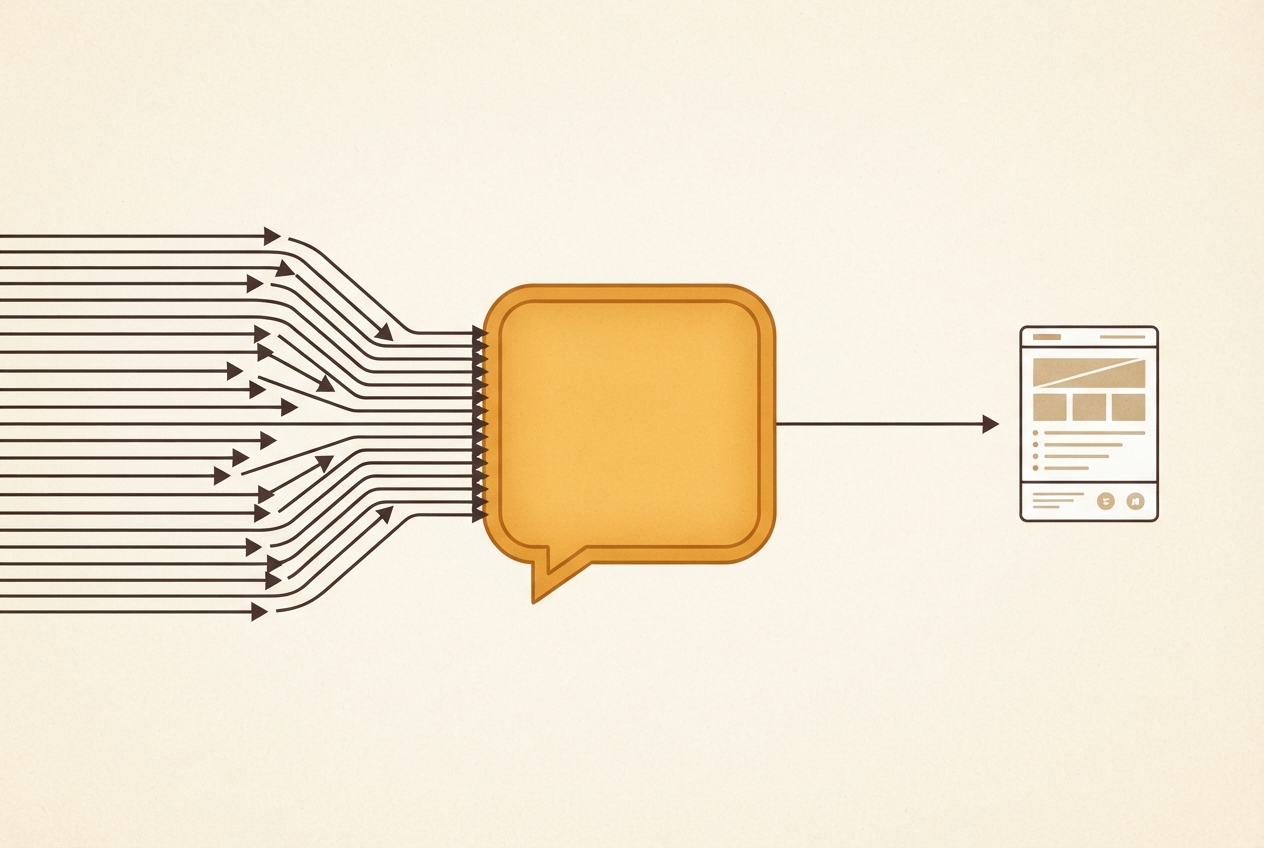
Read those three lines together and the shape of the change is obvious. The AI summary does not redistribute clicks to different winners. It removes the click. Being cited inside the answer earns you a 1% click-through, which means the citation itself, not the traffic it sends, is the thing worth having.
That is the actual difference between SEO and AEO, and everything else follows from it.
What genuinely changed
The unit of victory
SEO's unit was a position. There were ten of them, they were ordered, and you could watch yourself climb. AEO's unit is a mention: you are named in the answer or you are not. There is no fourth place, no gradual ascent, and no partial credit.
For a local business this is harsher than it sounds. Whitespark's 2026 study found AI Overviews on 68% of local searches against 39% for the traditional local pack, and on hybrid queries like "average cost of dental implants in Phoenix", 97%. Ten slots became roughly three, on the majority of searches.
The click stopped being the point
If you are used to justifying marketing spend with sessions, this is the uncomfortable part. A 1% click-through on citations means AEO cannot be evaluated by traffic. Its return arrives as the customer who already decided: someone who calls having been told you are the answer, and who never appears in your analytics as a search visit at all.
Your audience now includes a machine
SEO wrote for a person, with a crawler as intermediary. AEO writes for a model that will read your page, compress it, and restate it in its own words to someone who will never see your page. That changes the craft: you are not writing to persuade a reader, you are writing to be accurately quotable by something that will paraphrase you.
What did not change at all

Now the part the AEO vendors would rather you skipped.
The signals underneath are largely the same ones. Answer engines lean on authority, link graphs, entity consistency, review sentiment, and content relevance, because those are the signals that exist and that have proven predictive. A business with strong local SEO fundamentals starts this race a long way ahead.
Specifically, all of the following still matter exactly as much as they did:
- Being linked to by credible sites. Authority did not stop mattering because the output format changed.
- Consistent name, address, and phone everywhere. If anything this matters more, because a model that cannot resolve you to one confident entity will simply name a business it can.
- Crawlability and speed. A page a bot cannot fetch cannot be cited.
- Reviews. Still the loudest third-party signal a local business has.
The academic work points the same direction. The GEO paper that introduced generative engine optimization as a formal discipline reports visibility gains of up to 40% from optimizing content for generative engines, but as a boost layered on top of existing content, and with efficacy that varies considerably by domain. It is an uplift on a foundation, not a replacement for one.
If you have never done local SEO, do not skip it to do AEO. AEO is what you add once the foundation is there.
The differences that actually change your to-do list
| SEO | AEO | |
|---|---|---|
| Goal | Rank in a list | Be named in an answer |
| Slots available | ~10 | ~3 |
| Success looks like | A click | A mention, often with no click |
| Measured by | Position, sessions | Citation rate across engines |
| Content that wins | Comprehensive pages | Short, self-contained, quotable claims |
| Where the answer comes from | Your site | Reviews, directories, forums, your site |
| Stability | A rank holds for weeks | The answer can change between two asks |
The last row is the one people underestimate. A ranking is a stored value; an answer is generated fresh each time. Two customers asking the same question in the same city can get different businesses. That is not noise in your measurement. It is the measurement, and it is why sampling repeatedly beats checking once.
The 67-word constraint
Here is the most practically useful thing in the Pew data, and almost nobody talks about it: the median AI summary in the study was 67 words long, and 88% of them cited three or more sources.
Sit with those two numbers together. Roughly 67 words, split across at least three sources. Your share of a typical AI answer is a sentence or two.
That reframes what "good content" means. A 3,000-word guide is not what gets extracted. One clean, self-contained, checkable sentence is. Which means:
- Lead with the claim. The answer to the page's title question belongs in the first sentence, not after four paragraphs of context.
- Make each fact survive removal from its page. "Roof replacement in Austin runs $9,000–$22,000" works alone. "As we discussed above, it varies" does not.
- Put the number in the text. Not in an image, not behind a calculator, not in a PDF.
- One idea per paragraph. You are writing extractable units, not prose that builds.
Length still helps you get considered. Depth is how a page earns topical authority. But the thing that gets quoted is short. Write long pages made of short, liftable claims.
How to measure it

Rank trackers do not answer the AEO question, because there is no rank. The measurement is different in kind:
- Start from questions, not keywords. The unit of AEO is the question a customer actually types.
- Sample each question repeatedly, across engines. One check tells you nothing, because the answer is regenerated each time. A distribution over several checks tells you your real hit rate.
- Record who else was named. Your competitive set in AI answers is often not the set you assumed.
- Track the direction, not the day. Whether your citation rate on a question is rising is the only metric that survives the volatility.
None of this shows up in Google Search Console, which is why most businesses have no idea where they stand.
If you can only afford one
You cannot really choose, but you can sequence, and the ordering is not what most agencies will tell you.
Fix the foundation first, listings that agree with each other, a crawlable site, reviews with real text in them. This serves both disciplines and costs mostly time.
Then write for extraction, cost pages, insurance and eligibility pages, comparison pages, "how to choose" pages, each leading with the answer. This is where AEO diverges from a traditional content plan, and where the gains are.
Then measure citation, not rank. Otherwise you will optimize for a number that no longer predicts revenue.
The businesses that will do well here are not the ones that abandoned SEO. They are the ones that already had the fundamentals and added an extraction layer on top.
FAQ
Is AEO just a rebrand of SEO?
No, but the overlap is real. The underlying signals, authority, entity consistency, reviews, crawlability, are largely shared, so strong SEO gives you a real head start. What changes is the output you are optimizing toward: a citation inside a generated answer rather than a position in a list, measured by mention rate rather than clicks.
What is the difference between AEO and GEO?
Mostly vocabulary. Generative engine optimization (GEO) is the term the academic literature adopted; answer engine optimization (AEO) is the term the industry uses. Both describe making your content the thing a generative system cites. Where people do distinguish them, AEO leans toward direct-answer surfaces like AI Overviews and GEO toward chat-style generative engines.
Should I stop doing SEO?
No. Answer engines draw on the same authority and relevance signals search engines do, so cutting SEO would weaken your AEO position. The change is one of emphasis: less effort chasing positions on head keywords, more on being the clearest available source for the specific questions your customers ask.
Do AI citations actually send traffic?
Barely. Pew found people clicked a link inside an AI summary in about 1% of visits. The value of a citation is the recommendation itself, a customer who arrives already convinced, often by phone or direct visit rather than a tracked click. Judge it by inbound intent, not sessions.
How do I know if my business is being named by AI?
Ask. Write down the ten questions a customer would type before hiring you, run each through ChatGPT, Google, and Perplexity with your city named, and record who gets mentioned. Repeat it, because the answers vary between asks. Doing this on a schedule across engines is exactly what Kaymak automates.
Does content length still matter?
Yes, but for a different reason than before. Depth is how a page earns the authority to be considered at all. Extraction, though, is short, the median AI summary in Pew's data was 67 words drawn from three or more sources. Write substantial pages assembled from short, self-contained claims that survive being lifted out.
The short version
The click is going away on the queries that matter most, and it is not coming back, 8% versus 15%, and 1% on the citations themselves. What replaces it is being named, which is worth more per instance and far harder to measure.
The good news is that most of the work you have already done still counts. The new work is narrow and specific: write claims that can be lifted out of your page intact, and start measuring whether they are.
If you want to see where you currently stand, the live demo shows the full picture for a sample business, which questions get answered, who gets named, and why. Free, no signup. Or read the vertical guides for dentists and therapists, or start with what answer engine optimization is.
Sources: Pew Research Center, Google users are less likely to click on links when an AI summary appears · Aggarwal et al., GEO: Generative Engine Optimization (arXiv) · Whitespark, The prevalence of AI Overviews in local search