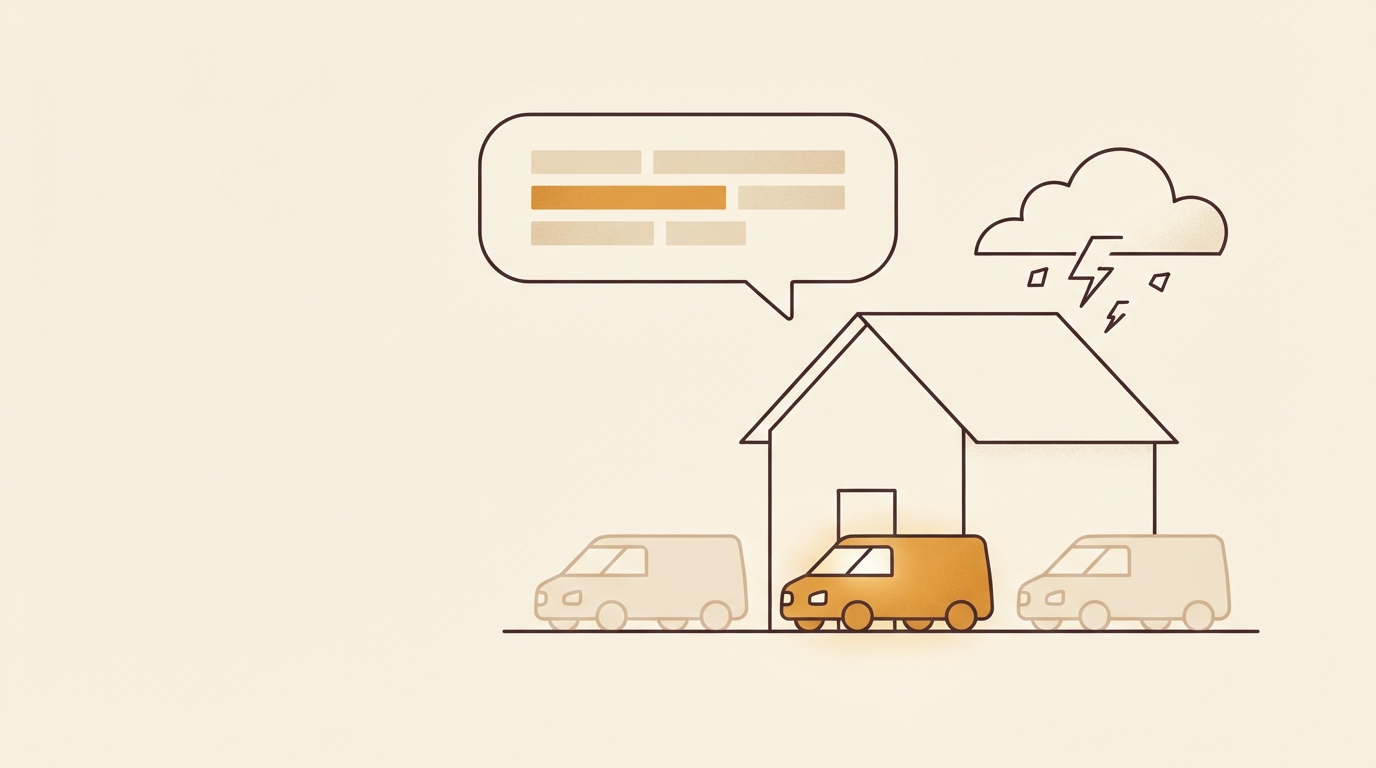
The National Insurance Crime Bureau reports that instances of contractor fraud rose 38% from 2023 to 2025, a stretch in which the U.S. absorbed 23 separate billion-dollar disasters and roughly $115 billion in damage. Manufactured roof damage sits at the top of the list of schemes they name.
So the NICB tells homeowners what every consumer body now tells them: reject unsolicited offers, refuse pressure to decide quickly, get multiple estimates, verify references before signing anything.
Follow that advice for a second. A homeowner sends the door-knocker away, goes inside, and starts researching. Where? Increasingly, they open ChatGPT or type a question into Google and read the AI answer.
That is the shift that matters for roofing. The AI answer has quietly become the vetting step, the thing that stands between a storm-damaged homeowner and a contractor. Whoever it names has been pre-vetted on the homeowner's behalf.
Roofing is not like other local trades
Two things make this vertical its own problem.
Demand is event-driven. A dentist's demand is roughly flat. Yours arrives in violent spikes when weather hits, and in the two weeks after a hailstorm your market's entire year can be decided.
Trust is the scarce commodity. Storm chasers, transient crews that follow weather across the country, arrive within 48 to 72 hours, door-knocking before homeowners have had time to think. Their customers are frequently left with voided manufacturer warranties, unenforceable workmanship guarantees, and no recourse once the crew has moved to the next market.
The consequence is that homeowners in your market are primed to distrust roofers in general, including you. Every honest local roofer is paying a tax levied by the chasers.
You cannot build authority during the spike

Here is the part that catches roofers out.
When the storm hits and a thousand homeowners in your county start asking questions, the answer engine assembles its response from what already exists: the reviews you already have, the pages already crawled, the corroboration already in place. Publishing a cost page the week after a hailstorm is publishing it too late for that storm; a new page has to be crawled and then earn enough trust to be quoted, which is a matter of weeks, not days.
AEO for roofing is off-season work that pays out in-season. The quiet months are not downtime; they are when the answer for the next storm gets written.
This inverts the usual roofing marketing calendar, where spend surges after the weather. Ad spend has to be reactive. Visibility work cannot be.
The most valuable page a local roofer can write
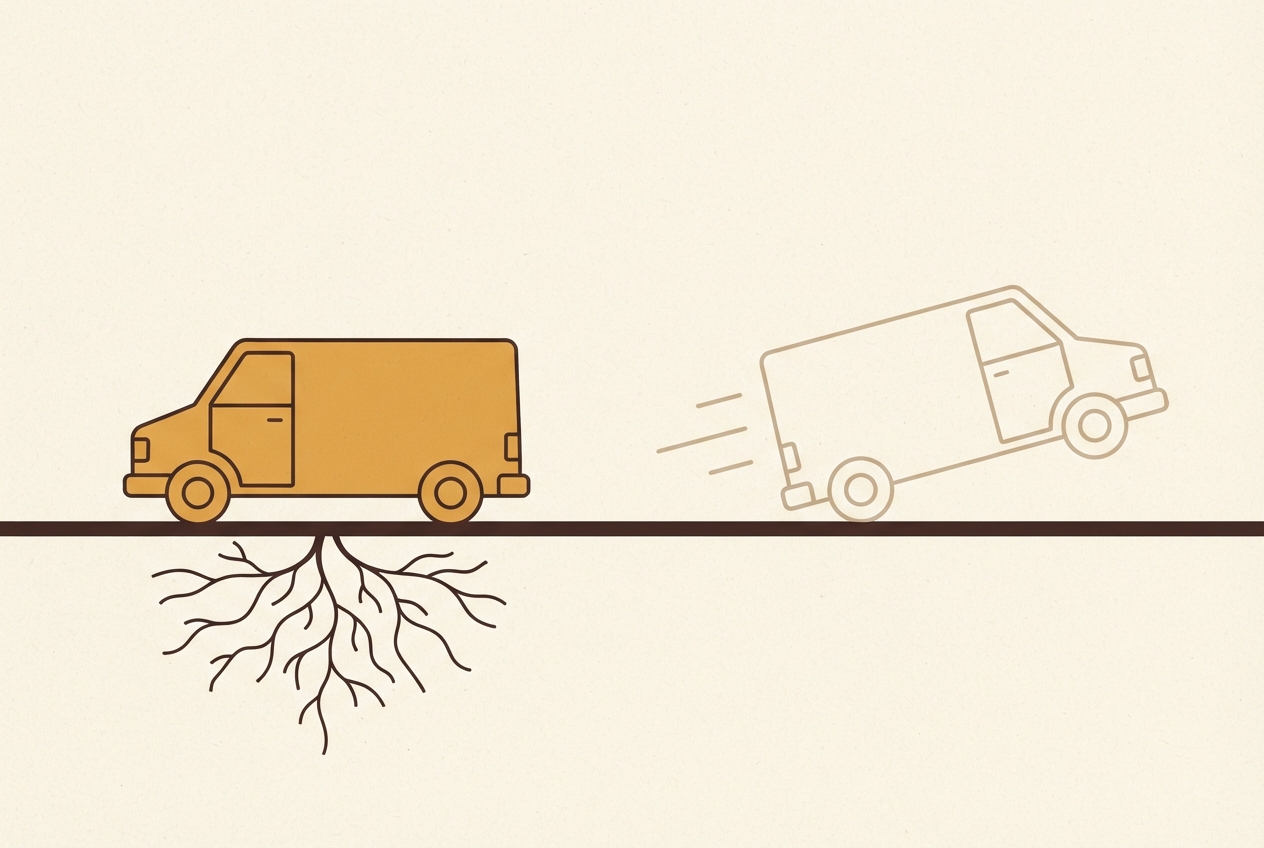
Most roofing sites lead with "quality workmanship" and a gallery. Meanwhile the question homeowners are actually asking an AI, at the exact moment of highest intent, is some version of:
How do I tell a legitimate local roofer from a storm chaser?
Almost nobody has written the honest, specific answer to that, and a genuine local roofer is the most credible possible author of it.
Write it. Lay out the real signals: a physical local address you can visit, a state contractor licence number stated in text, manufacturer certifications that require an established business, a workmanship warranty that survives because the company will still be here, references from named local neighbourhoods, and no pressure to sign at the door. Include the NICB's own guidance and link to it.
That page does three things at once. It answers a high-intent question the AI is being asked. It positions you as the trustworthy option without you having to claim you are trustworthy. And it is the kind of question-shaped, checkable content the filtering step in how an engine picks a business actually rewards.
The counter-intuitive part: publishing a guide that helps homeowners scrutinise roofers is better marketing than publishing one that praises you.
The cost page you keep not writing
Roof replacement cost is a hybrid intent query, cost plus location, and that is the single most AI-answered query shape there is. In Whitespark's 2026 study of local searches, hybrid queries like "average cost of dental implants in Phoenix" triggered an AI Overview 97% of the time. "Roof replacement cost in [your city]" is the same shape.
Which means the homeowner is getting a number whether you provide one or not. Right now that number is coming from a national aggregator with no knowledge of your market.
Publish real ranges for your metro. Break them down by the things that actually move the price, square footage, pitch, tear-off layers, material, decking repairs. Explain why the range is wide instead of hiding behind it. "Call for a free quote" is invisible to an answer engine, and it reads as evasive to a homeowner who was just warned about contractor fraud.
The same applies to the insurance question. "Does my insurance cover a roof replacement", "what is an ACV versus replacement cost policy", "will filing a claim raise my premium", these are the questions between the damage and the job, and answering them plainly makes you the source that gets quoted.
What a citation is actually worth

Roofers are unusually well placed to value this, because you already buy leads and you know what they cost.
Shared leads from the major marketplaces run roughly $45 to $120 each for roofing work, on top of an annual membership, and each is sold to somewhere between three and eight contractors. With shared-lead close rates in the 8–20% band, published benchmarks put the true cost per booked job somewhere between $500 and over $1,250. Response time swings it hard: being first to call within a few minutes can put a booked job near $580, while being third in the rotation twelve minutes later pushes it past $1,500.
Now compare the alternative. A homeowner who asks an AI which local roofer to call, and is given your name with a reason, arrives having already done the vetting the NICB told them to do. There is no rotation, no race to dial first, and no per-lead fee. The economics are not close.
The catch, and it is a real one, is that this is not instant and not purchasable. You cannot buy a citation. You earn it with the same unglamorous work every time.
Before the next storm
A sequence you can actually run in the off-season:
- Fix the boring foundation. Consistent name, address, phone, and service area everywhere; a site a crawler can read; indexed in Bing as well as Google, since that is how ChatGPT finds candidates.
- Write the storm-chaser guide. The highest-intent, least-contested page in your market.
- Write the cost page. Real ranges, your metro, itemised drivers.
- Write the insurance-claim page. ACV versus RCV, the process, what you do and do not handle.
- Ask for specific reviews. Not "leave us a review" but "if you can mention that we handled the insurance claim and finished in two days, that helps enormously." Engines quote language; give them language worth quoting.
- Get corroborated locally. Manufacturer certification directories, the local BBB, chamber listings, the regional trade association, and any local news coverage of your storm response work.
Then measure whether it worked, by asking the questions your customers ask, on a schedule, across engines, and tracking whether you get named.
FAQ
When should a roofing company do AEO work?
In the off-season. When a storm hits, the answer engine composes its response from content that has already been crawled and corroborated, so a page published the week after a hailstorm arrives too late for that storm. Visibility work done in quiet months is what pays out during the next spike.
What is a storm chaser and why does it matter for my marketing?
A storm chaser is a transient contractor that follows severe weather between markets, typically door-knocking within 48 to 72 hours of a hailstorm before homeowners have researched their options. It matters because their conduct has made homeowners suspicious of roofers generally, which means content that helps a homeowner tell the difference is unusually valuable, and unusually credible coming from an established local company.
Should I publish roof replacement prices on my website?
Yes. Cost-plus-location questions are the most reliably AI-answered query shape there is, so a homeowner will be given a number whether or not it comes from you. A real range for your metro with the factors that move it will be quoted; "contact us for a free estimate" will not, and reads as evasive to someone who was just warned about contractor fraud.
Is AI visibility cheaper than buying roofing leads?
Per acquisition, substantially, shared marketplace leads work out at roughly $500 to $1,250 per booked job once close rates are accounted for, while a citation carries no per-lead fee and arrives pre-vetted. The trade-off is that citations cannot be purchased or switched on quickly; they are earned over weeks through consistency, content, and corroboration.
Do I still need Google Business Profile?
Yes. It remains a primary source of the entity facts engines use to describe you name, location, service area, hours, reviews, and inconsistency between it and your other listings is one of the most common reasons a model declines to name a business. Keep Bing Places and Apple Business Connect current for the same reason.
How do I know if AI is recommending me?
Ask it, repeatedly. Take the ten questions a homeowner asks after storm damage, run them through ChatGPT, Google, and Perplexity with your city named, and record who gets named. Because answers are generated fresh each time, one check is noise; the rate across repeated samples is the signal.
The short version
Homeowners are being told, correctly, to send the door-knocker away and go research instead. That research is increasingly an AI answer, which makes the answer the new vetting step in a trade where trust is the scarce good.
You cannot win that answer during the storm. It is assembled from what already exists. So the work is off-season: fix the entity basics, write the storm-chaser guide nobody else will write, publish real prices and a plain insurance explainer, and collect reviews that say specific things. Then check whether it is working before the sky decides for you.
Kaymak asks the questions your customers ask across ChatGPT, Google AI Overviews, and Perplexity, records who got named and why, and turns the gaps into a ranked to-do list. The live demo is free to explore, no signup.
Sources: NICB, Contractor fraud continues to rise nationwide · Roofing Contractor, The honest roofer's playbook for post-storm trust · Whitespark, The prevalence of AI Overviews in local search